The Science of Waterproof Breathable Fabrics: How They Work and What to Look For
Waterproof breathable fabric solves a contradiction: keep liquid water out while letting sweat vapor escape. The physics is elegant, the engineering is demanding, and the marketing around it is often misleading. This guide explains how the technology actually works and how to read the numbers - so you can specify fabrics on evidence rather than hangtags.
For rating comparisons and product-level application, see our waterproof rating guide and waterproofing technology guide.
The Paradox and How Membranes Solve It
The trick relies on scale. A water droplet is roughly 100 microns across; a water vapor molecule is about 0.0003 microns. A membrane with pores around 0.1-1.0 micron blocks droplets while passing vapor - three orders of magnitude of separation on each side.
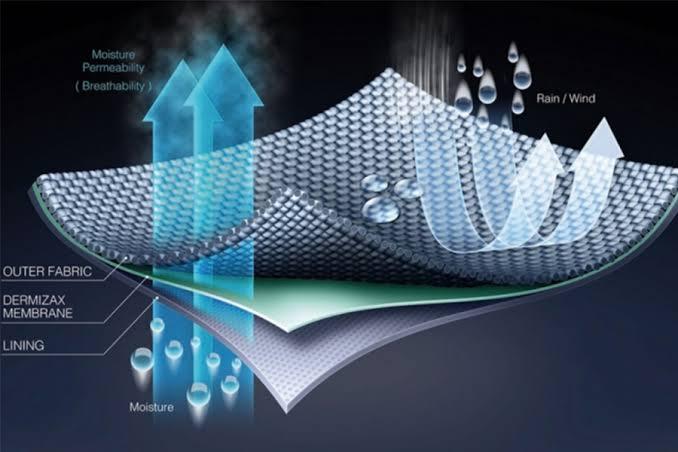
Two membrane families dominate. Microporous membranes (ePTFE - expanded polytetrafluoroethylene, used by Gore-Tex and eVent) physically perforate the membrane with billions of micro-pores. Hydrophilic membranes (most PU-based systems) have no pores; instead, water vapor molecules are absorbed onto the membrane's inner surface, diffused along a molecular chain, and re-evaporated on the outside - solid-state transport driven by the humidity gradient between your skin and the air. Microporous systems breathe faster in dry conditions; hydrophilic systems are more tolerant of contamination and stretching.
The membrane is always laminated to a face fabric for protection and structure - and that assembly is what the industry calls a 2-layer, 2.5-layer, or 3-layer laminate. Our membrane comparison guide covers the construction trade-offs in detail.
Add photo here: magnified cross-section view showing membrane laminated between face fabric and lining layers
DWR, Seams, and the Complete System
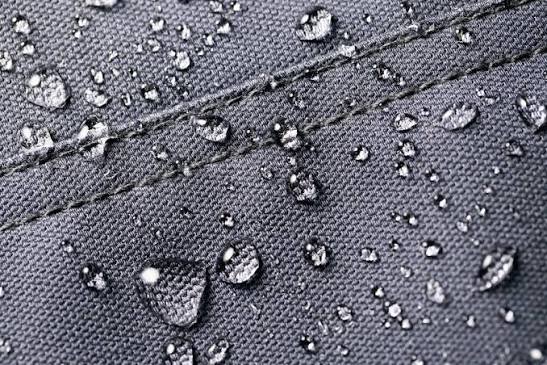
The membrane is only one component. The DWR (durable water repellent) finish on the face fabric raises the surface's contact angle so water beads and rolls off instead of wetting the fabric. Why it matters: a soaked face fabric ("wetting out") blocks the vapor path and makes even the best membrane feel like a rain barrel. DWR chemistry is in transition - long-chain fluorocarbon (C8) finishes are being phased out under PFAS regulations, replaced by shorter-chain C6 and fluorine-free alternatives that trade some oil repellency for environmental safety. Our PFAS-free explainer covers the regulatory timeline.
Seams are the weak point. Every needle hole is a water highway, so stitched waterproof garments require heat-applied seam tape - a hot-melt adhesive film bonded over every seam on a pneumatic press. Sew-free bonding (ultrasonic welding, hot-melt film lamination) eliminates the holes entirely and dominates in premium construction. A garment's waterproofness is governed by its weakest system element: a 20,000 mm membrane with untaped seams is a sponge with good marketing.
Reading the Numbers: RET, MVTR, and Hydrostatic Head
Hydrostatic head (mmH2O) measures waterproofness: how tall a column of water the fabric resists before leaking (ISO 811 / AATCC 127). 1,500 mm resists light rain; 10,000 mm handles sustained downpours; 20,000+ mm serves extreme and professional use. Laboratory values decline with flexing, abrasion, and washing - real-world durability matters more than day-one numbers.
RET (ISO 11092) measures evaporative resistance - how much the fabric slows vapor escape. Lower is better: 0-6 is extremely breathable, 6-13 is good, 13-20 is acceptable, 20+ is not breathable for active use. MVTR (moisture vapor transmission rate, g/m2/24h) is the alternative metric - higher is better, but test methods vary, so only compare MVTR numbers measured by the same method. When a brand quotes breathability without naming the metric and method, treat the number as decoration.
One honest caveat: in very humid conditions, the humidity gradient collapses and every membrane breathes worse - the physics has a ceiling. Ventilation features (pit zips, mesh pockets) remain legitimate performance tools, not design nostalgia.
Add photo here: laboratory technician conducting rain shower spray test on waterproof jacket fabric
Durability, Care, and Real-World Performance
Membranes age through three mechanisms: mechanical wear (flexing and abrasion delaminate coatings), contamination (dirt and detergents clog microporous pores and mask hydrophilic chemistry), and DWR depletion (the face fabric wets out, blocking vapor escape). Care extends life substantially: wash with technical cleaner, skip fabric softener (it kills DWR), and periodically apply gentle heat (tumble dry low or iron on low with a cloth) to redistribute and reactivate DWR chemistry. When beading permanently stops despite re-treatment, the garment is at end of life for its waterproof rating.
For specifiers: require wash-cycle durability data (how many washes the rating survives), because a fabric that tests at 10,000 mm new but 3,000 mm after 10 washes is a different product than one holding 10,000 mm through 20 washes.
Sustainability and Innovation Directions
The industry's environmental direction is clear: fluorine-free DWR as default (regulation-driven in the EU, expectation-driven elsewhere), recycled face fabrics and backer textiles, bio-based membrane chemistry emerging from laboratories, and design-for-recyclability - mono-material laminates that can actually be separated at end of life. Claims should be verified: GRS certifies recycled content, and OEKO-TEX covers harmful substances. Our GRS guide and certifications explainer cover verification.
UniOuter manufactures with the full system in mind: pneumatic flat-press seam taping, sew-free bonding capability, in-house fabric development including fluorine-free DWR options, and third-party testing against the metrics above. Explore the fabric development page, browse the product catalog, or send an inquiry with your target specs. More about our 20-year manufacturing base is on the about page, and the purchasing guide covers commercial details.
Shop Waterproof Jackets


Frequently Asked Questions
Not necessarily. Beyond about 20,000 mm, additional waterproofness adds cost and often reduces breathability, while virtually no rain generates that pressure in real use. Durability of the rating through wash cycles, seam construction, and DWR performance usually matter more than chasing bigger numbers.
That is DWR depletion. When the face fabric soaks, its water layer blocks vapor transfer and conductive cooling makes the garment feel cold and clammy. Wash the garment with technical cleaner, then apply gentle heat to reactivate the DWR. If beading never returns, re-treat with a wash-in or spray-on repellent - or accept the garment is due for replacement.
RET measures resistance to vapor escape (lower is better); MVTR measures the amount of vapor passed in 24 hours (higher is better). RET is the more standardized method; MVTR numbers are only comparable when measured by the same test protocol. Ask manufacturers which method they quote.
Marginally - the membrane does the breathing in all three. The differences are weight, durability, and comfort: 3-layer laminates are the most durable and packable; 2-layer with a hanging liner is more comfortable and cheaper; 2.5-layer is the lightweight compromise. See our construction comparison for details.
For water repellency, modern fluorine-free DWR is close - with more frequent reactivation needed. The real gap is oil and dirt repellency, where fluorinated chemistry remains superior. For most outdoor apparel, the performance trade-off is acceptable, and PFAS regulations are making the decision anyway. Details in our PFAS-free guide.