EU Textile EPR and the Unsold-Goods Ban: What They Change for 2027 Outdoor Apparel Orders
For years, over-ordering was cheap insurance against a stockout. Two EU measures are making it expensive, and both change what a sensible order quantity looks like.
This guide explains mandatory textile extended producer responsibility and the ban on destroying unsold apparel, then translates them into changes a buyer can make to a 2027 order plan: smaller first drops, staged deliveries and durability that earns a lower fee. It follows our 2027 procurement calendar and pairs with the cost work in our manufacturing economics guide.
What Textile EPR Actually Does
Extended producer responsibility makes the party placing textiles on the market pay for what happens at end of life: collection, sorting, preparation for reuse, recycling and treatment. It is set out in the revised Waste Framework Directive, Directive (EU) 2025/1892, with member states required to establish schemes and producers financing them. The mechanism fits inside the broader EU circular economy programme.
The design detail that matters commercially is eco-modulation. Contributions can be adjusted according to product characteristics linked to durability, circularity and waste prevention, and member states may differentiate further for fast-fashion practices. In plain terms, a garment built to last and to be recycled attracts a lower fee than one designed for a single season. The fee is charged to the brand, but it flows back up the supply chain as a price expectation.
What this means for a specification. Durability is no longer purely a customer-satisfaction issue. It is a cost line. A heavier face fabric, a repairable construction or a mono-material build that recycles cleanly can reduce a brand's EPR contribution, which changes the acceptable unit cost of the garment.
The Unsold-Goods Ban
Alongside EPR, the EU has moved against the destruction of unsold consumer products. Measures adopted under the Ecodesign framework support a prohibition on destroying unsold apparel, clothing accessories and footwear, with obligations arriving first for large companies and later for medium-sized ones. Companies are also expected to disclose information about unsold products discarded as waste.
The framework that houses this is the Ecodesign for Sustainable Products Regulation, Regulation (EU) 2024/1781, and the wider policy context is the EU textiles strategy. For a buyer, the practical effect is that the old disposal route for leftover stock is closing. Excess inventory now has to be re-sold, re-purposed or recycled, and all three cost more than not producing it.
What Changes in a 2027 Order Plan
| Old habit | New pressure | Practical adjustment |
|---|---|---|
| One large seasonal drop | Unsold stock cannot be destroyed; EPR fees scale with disposal cost | Smaller first drop with a staged replenishment window written into the PO |
| Chasing the lowest unit price | Durability and circularity reduce EPR fees and improve tender scores | Accept a modest unit premium for construction that earns a lower fee |
| Single-season colour bets | Dead stock is expensive to hold and hard to liquidate | Anchor the range in carry-over colours and use accents for trend exposure |
| Disposal as the final option | Destruction prohibition and disclosure obligations | Plan resale, donation or recycling routes before placing the order |
| MOQ as the only constraint | Total cost of ownership now includes fee and disposal | Optimise on landed cost plus EPR, not on unit price alone |

Design Choices That Lower the Fee
- 1. Mono-material construction. A garment made predominantly from one fibre family recycles more cleanly and is easier to process, which supports a lower fee than a complex blend.
- 2. Replaceable components. Zips, cuff tabs and linings that can be replaced extend service life and reduce the volume entering the waste stream.
- 3. Higher face-fabric durability. Abrasion resistance and colourfastness after repeated washing are the measurable durability signals that fee structures recognise.
- 4. Repair information. Care and repair guidance shipped with the garment supports the lifecycle evidence brands are increasingly asked to provide.
- 5. Recycled content with certificates. Certified recycled content improves the circularity profile, and the transaction certificate is what makes the claim scoreable.
- 6. Planned carry-over. Designing part of each range as a multi-season carry-over colour reduces the volume that becomes dead stock at all.
Working With the MOQ Reality
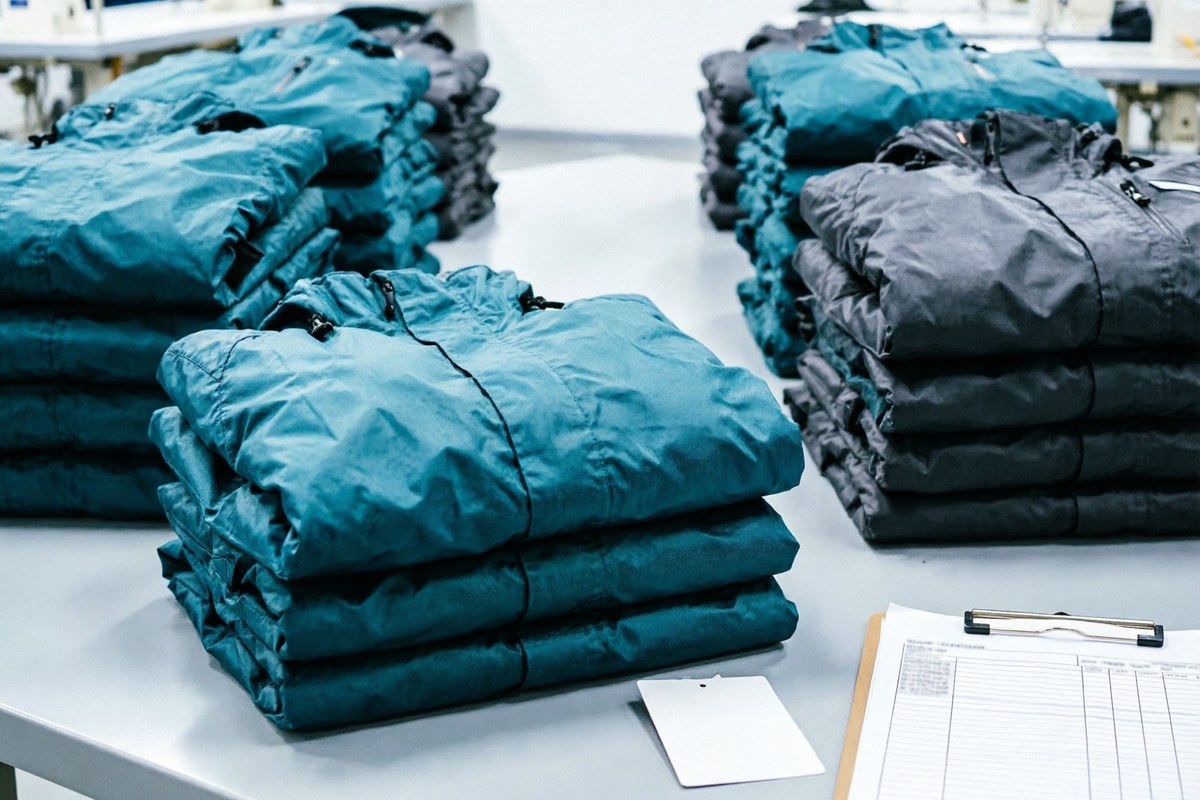
Smaller first drops conflict with minimum order quantities, which is the practical tension in this whole shift. There are three ways buyers resolve it. The first is to split a style across sizes so the total still meets the minimum while the first delivery is smaller. The second is to stage deliveries within one purchase order, producing to a schedule rather than to a single shipment. The third is to work with a manufacturer who holds the fabric and can top up mid-season without new sampling. All three depend on a supplier relationship that is set up for replenishment rather than for one-off orders.
Customs and import mechanics also matter when deliveries are staged rather than shipped in one lot. The EU Access2Markets helpdesk is the reference point for the import requirements that apply to each shipment.
Where UniOuter Fits
We support staged delivery as a standard option rather than an exception, hold fabric on carry-over colours so replenishment does not require re-sampling, and build constructions that score well on durability and recyclability. That combination is what makes a smaller first drop workable without losing the price benefit of a full production run. To plan a 2027 order with staged deliveries, send your forecast through our inquiry page.

Shop Waterproof Outerwear
Frequently Asked Questions
The producer placing the product on the EU market, which is normally the brand or importer. Member states set up schemes under Directive (EU) 2025/1892, and contributions can be eco-modulated by durability, circularity and waste prevention, so better-designed garments attract lower fees.
Measures adopted under the Ecodesign framework support a prohibition on destroying unsold apparel, clothing accessories and footwear, arriving first for large companies and later for medium-sized ones. Companies are also expected to disclose unsold products discarded as waste, so disposal is no longer a quiet option.
Not automatically, but the calculation has changed. Total cost of ownership now includes the EPR contribution and the cost of handling any excess. A smaller first drop with a staged replenishment window often costs less in total than one large shipment that leaves dead stock.
Three practical routes: split a style across sizes so the total meets the minimum while the first delivery is smaller; stage deliveries inside one purchase order; or work with a manufacturer who holds fabric and can replenish mid-season without new sampling.